core.validateInstances
Extend a definition instance viewer capabilities with a custom validator.
Usage:
javascript
 core.validateInstances("<definition-name>", function (instance, successCb, failCb) {
   ...
})

 core.validateInstances("<definition-name>", function (oldInstance, instance, successCb, failCb) {
   ...
})
Arguments:
| Argument | Description | Required |
|---|---|---|
definition-name | Refers to the name of the specific definition to which you want to apply the customization. | YES |
function | callback function that will be invoked to perform the custom validation and that holds the data and contains all logic | YES |
Function arguments:
| Argument | Description |
|---|---|
oldInstance | The initial state of the instance before any changes. |
instance | The new instance state reflecting any user changes. |
successCb | This is the callback function that will should be invoked if the validation succeeds |
failCb([fail1,fail2, ...]) | This is the callback function that should be invoked if the validation fails. It has the option to accept an array of objects containing failure information for each instance field. |
Function `failCb` failure object structure:
| Argument | Description | Required |
|---|---|---|
fieldId | The field id with the error. | YES |
localizedMessage | The error message | YES |
l10nSource | The custom translation file | NO |
l10nArgs | The arguments to use in the translation message | NO |
TIP
The displayed errors can be translated. To enable this feature, you need to have the translation dictionary available on your server at server_*/recordm/customUI/i18n/<custom-translation>_<lang>.json. For further details, refer to this link.
### Examples:
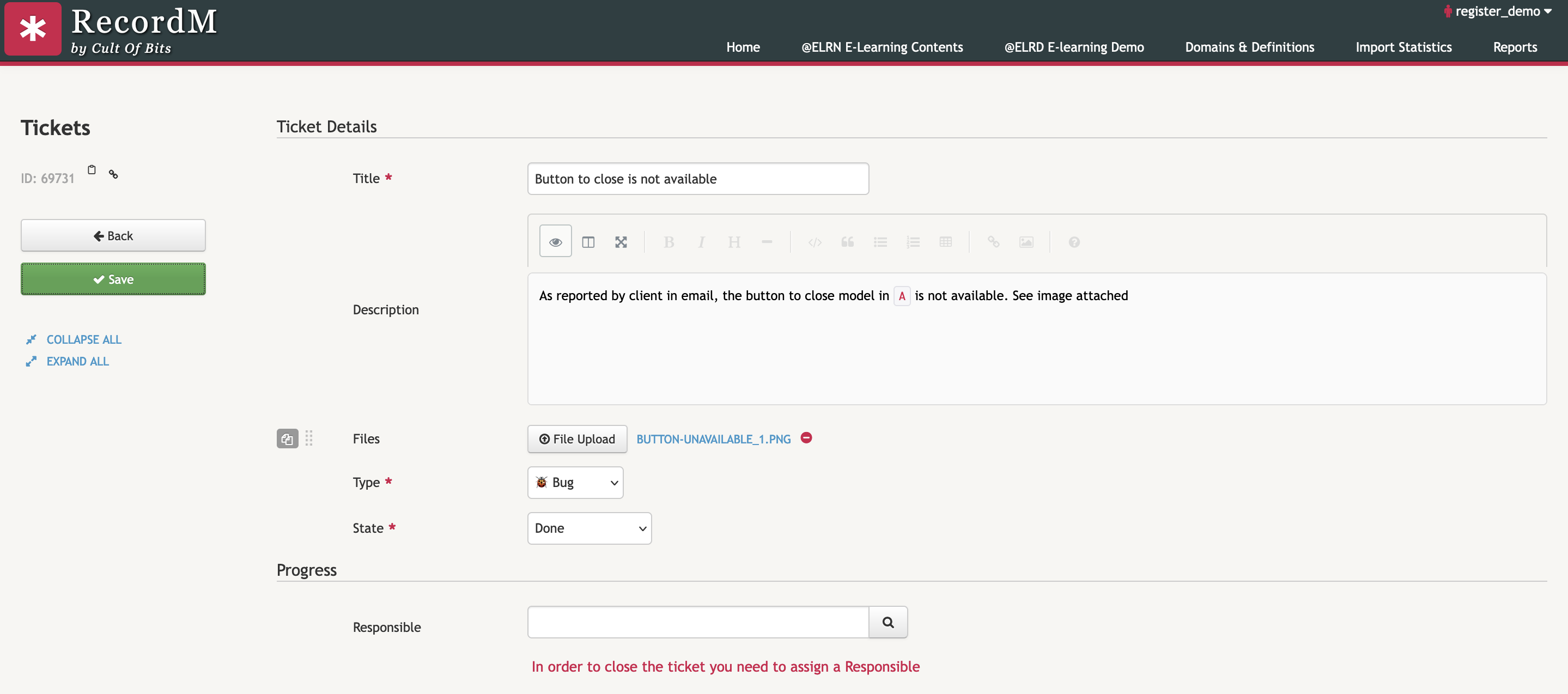
The following code snippet ensures that a ticket cannot be closed without assigning a 'Responsible'. Therefore, if a user attempts to change the state to 'Done' and clicks the 'Save' button, the validation will fail.
javascript
// recordm/customUI/i18n/tickets_en.json

{
  "required": {
    "done": {
      "responsible-missing": "In order to close the ticket you need to assign a Responsible"
    }
  }
}
javascript
cob.custom.customize.push(function(core, utils, ui) {
  const DEFINITION = "Tickets";

  core.validateInstances(DEFINITION, function(instance, successCb, failCb) {
    const stateF = instance.findFields("State")[0];
    const responsibleF = instance.findFields("Responsible")[0];

    if (stateF.value === "Done" && !responsibleF.value) {
      failCb([{ fieldId: responsibleF.id, localizedMessage: "required.done.responsible-missing", l10nSource: "tickets" }]);
      return
    }

    successCb()
  });
});